

 REQUEST INVITE
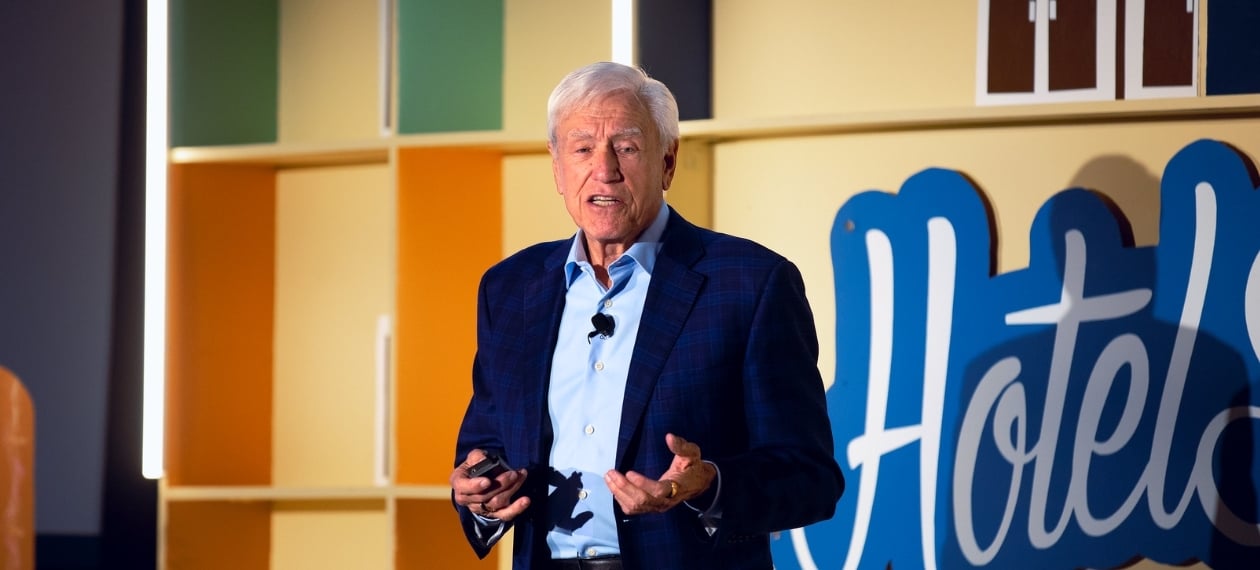
Ben Lytle spent six months in Italy writing a book. He'd occasionally pick up his grandkids at a parking lot outside Florence, where visitors leave their cars before heading into the city.
There were usually 15 or 20 taxis waiting there. After dark, Lytle kept noticing the glow of phone screens inside the cars.
So he asked the drivers what they were doing.
About a third were studying to become tour guides, which would allow them to make more money by doing both jobs. Others were studying for degrees. Some were playing games.
"That's how society moves up," one driver told him. "We don't even notice it."
For Lytle, founding CEO of Anthem and author of The Potentialist series, that's what change often looks like.
It doesn't necessarily arrive with a big announcement. People start adapting. New skills become valuable. Old assumptions stop making sense. And by the time everyone else sees it, the shift is already underway.
At HotelSpaces, Lytle's challenge to the room was simple: pay attention.
"You're not bystanders. You're leaders. You're going to shape what this new reality becomes."
The workforce math is changing
One of the biggest changes Lytle believes leaders aren't paying enough attention to is demographics.
The number he wants leaders to remember is 2.1, the births per woman needed to keep a population stable. According to Lytle, not one developed country is currently at that level. He pointed to China and several southern European countries at roughly 1.3.
He calls population decline "the black swan of our time."
For business leaders, his questions are pretty practical.
"How do you grow an economy when there are fewer consumers every year? How do you staff your companies when there are fewer people every year?"
His answer is productivity.
"We can't do it by working any harder. Everybody's pretty well maxed out."
That's a familiar problem in hotel construction, where experienced people are already stretched across increasingly complicated projects and skilled labor remains hard to find.
That's where AI enters Lytle's argument. If fewer people are available to do the work, productivity has to increase.
"If we don't aggressively implement AI, we're going to fall behind."
For hotel design and construction leaders, that raises a more useful question than whether AI is coming. Where can technology actually remove work, speed up decisions or give experienced people more time to focus on the things that require their judgment?
Because asking the same teams to simply do more isn't much of a strategy.
Nobody rebuilds carburetors anymore
Lytle grew up on a ranch in Texas and hated working on cars.
One day, his uncle asked him, "Son, how in the world are you going to make it in this life if you don't learn how to take apart a carburetor and put it back together?"
About five years later, fuel injection arrived.
Nobody needed to rebuild carburetors anymore.
Every generation has skills it assumes will always matter. Technology has a habit of changing the list.
For hotel design and construction leaders, the question isn't whether today's expertise still matters. It's which skills become more valuable as AI takes on more of the routine work.
Knowing how to evaluate a tradeoff, catch a bad assumption, manage a complicated project or make the right call when the answer isn't obvious may matter even more.
The expertise doesn't disappear. Where people add the most value may.
From org charts to "special forces" teams
Technology isn't the only thing Lytle thinks will have to adapt.
People can change their behavior quickly. Organizations tend to move much slower.
He used transportation as a simple example: taxis out, Uber in, Waymo next.
Companies have departments, processes and layers of decision-making that are harder to change overnight.
"The organization structure we've got in business today doesn't work very well in a rapidly changing environment," Lytle said.
His prediction is that organizations will eventually look "a lot more like special forces teams," bringing people together around a particular mission rather than relying entirely on traditional structures.
Hotel projects already work this way. A conversion can quickly become an infrastructure problem, an operations problem, a brand problem and a budget problem at the same time. Solving it may require ownership, design, construction, engineering and operations around the same table.
Sometimes the people you need around the table matter more than the boxes they occupy on an org chart.
Information is everywhere. Wisdom isn't.
As information becomes easier to access, Lytle believes simply knowing more will matter less.
What becomes more valuable is knowing what to do with it.
His word for that is wisdom: "the art of making good decisions throughout your life."
And one of the skills behind it is what he calls "depth of inquiry."
"Many problems in our lives come about because we skim the surface and we don't go deep."
That may be the part of his argument that translates most directly to hotel design and construction.
Project leaders aren't short on information. They're deciding what is worth building, what to cut, what to preserve, where to spend, what to phase and which decisions will still make sense years from now.
AI can give people more information and potentially give it to them faster.
It can't make every decision for them.
Be a pace-setter
Toward the end of his talk, Lytle showed how people tend to respond to change.
Some resist it. Others eventually adapt. And a much smaller group starts moving early.
He calls them pace-setters.
"Every presentation's got an ask," he told the room. "Please be a pace-setter."
Which brings us back to that parking lot outside Florence.
Those taxi drivers didn't know exactly what their jobs would look like five or ten years from now.
They didn't need to.
They saw an opportunity to become more valuable and started learning the next skill while they waited for their next fare.
And while everyone else was going about their night, they were quietly getting ready.
Watch Ben's full HotelSpaces talk here 👇

Posted by
Join us at HotelSpaces!
A One of a Kind Retreat for Hotel Development, Design & Construction Leaders.
Oct 25 - 27 | Fort Lauderdale, FL
Learn More
-Feb-13-2026-09-45-32-3950-AM.png)
.png)
.png)


Comments