

 REQUEST INVITE
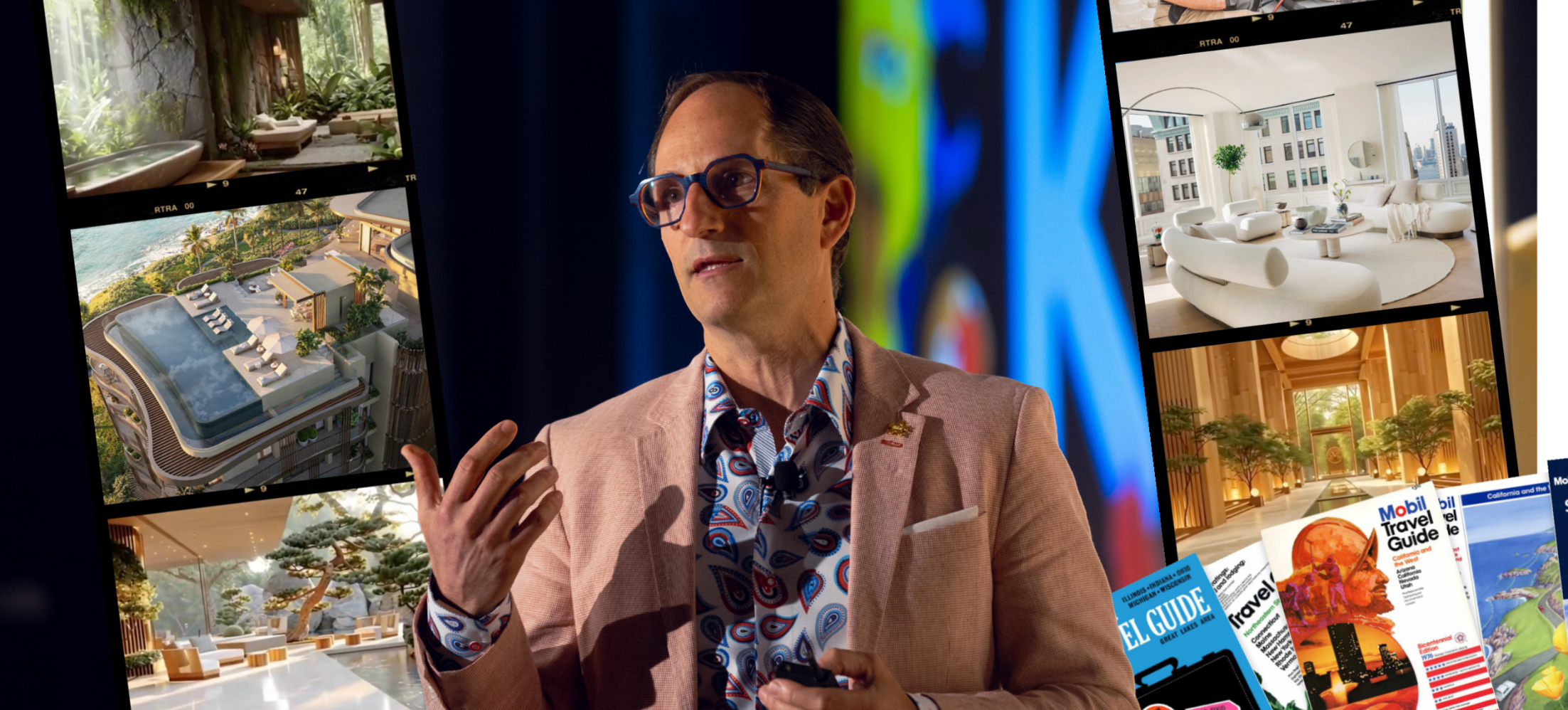
“I’ve been in a bathroom that felt the same in Tokyo, Berlin, and Austin, Texas.”
Stuart Greif wasn’t complaining about hotel design at HotelSpaces. He was diagnosing a problem the Forbes Travel Guide Chief Strategy, Innovation & Operating Officer calls “beigification,” what happens when brands play it safe at scale.
Sameness everywhere. Regional materials swapped for global supply chains. Local art replaced with corporate-approved neutrals. It’s efficient. It’s brand-consistent. And according to Greif, it’s exactly what younger travelers are rejecting.
They’re less brand loyal. They want authenticity, something that feels connected to place, not a bathroom they’ve seen on three continents.
But beigification is just a symptom. The real problem Greif addressed, the one he called “the elephant in the room,” goes deeper.
The hospitable part of hospitality has been squeezed out.
Here’s what happened. Hotels went asset-light, separating ownership from brands from management. That structure fueled explosive growth. It also created competing pressures. Owners chase margins. Brands protect their reputation while competing on fees. Operators deliver experience while cutting costs to satisfy both.
The result? Self-service kiosks. Opt-in housekeeping. Grab-and-go F&B that “makes sense cost-wise, but let’s be honest, that’s not really human connection,” Greif said.
Even five-star GMs feel it, especially when cost pressure never lets up.
And yet, the industry is booming.
The Boom Is Real
Leisure demand is about to drive “the largest runup in the net asset value in leisure hotels that we have ever had,” according to CBRE’s Bob Webster. Extended stay is up 5.5%. Every segment is growing.
Why? Travel is wired into human DNA. “We travel initially to lose ourselves, and we travel next to find ourselves,” Greif said, quoting travel writer Pico Iyer.
So here’s the tension. Build for a booming market where cost pressure never stops and guest expectations keep rising. Greif’s talk mapped the trends shaping what comes next.
Wellness Isn’t a Bolt-On
Stuart Greif pointed to a clear shift in why younger travelers are traveling. Gen Z increasingly views travel as a way to support mental well-being, with many returning feeling less anxious. These signals are already shaping expectations around hotel experience, space, and design.
Greif pushed for wellness integration from the start. “This notion of having a holistic view of physical, mental, social connection and wellness when you design, healthy air, water, lighting, sound, should be integral to how a property is designed and developed.”
That means in-room fitness options. Many women don’t feel comfortable going to windowless gyms late at night, he noted. It means thermal areas with modular solutions for back of house to reduce labor and cost. It means spaces for decompression that may not generate revenue per square foot but improve overall experience.
AI Is Already Here
Greif’s background is at Microsoft, where he discussed generative AI in 2017, years before ChatGPT. His take for construction professionals is simple. AI isn’t coming. It’s operational.
Two shifts matter now.
Search is changing. AI-driven search is beginning to change discovery in ways traditional SEO doesn’t account for. If large language models don’t understand a property’s unique features, travelers won’t find it. “It is vitally important that you talk with your teams now about when you develop your website, when you do marketing collateral, how are you being reflected in the large language model,” Greif said.
Physical automation is real. Specialized robots are already handling back-of-house delivery in China. Design must solve for these interactions, like delivery vestibules where guests receive items without staff or robots entering rooms.
Visual AI tools already create photorealistic renderings of hotels that don’t exist. That’s not future tech. That’s current workflow.
“AI may not replace you, but you might be replaced by somebody who knows how to use AI better,” Greif quoted from Harvard Business Review.
From Experience to Transformation
Greif referenced the shift from what he called the experience economy to the transformation economy, where guests aren’t just looking for memorable stays but for travel that changes them.
It sounds abstract. But it’s not. Are you building spaces that allow for reflection and genuine connection? Or just efficiently processing transactions?
The K-Shaped Reality
Greif also named the economic split happening in real time. At luxury, “it’s the best of times. ADRs are high. The wealth effect is strong.” But lower-income travelers are hurting, and that pressure is moving up the chain scales.
It’s creating what he called a K-shaped recovery. Two different markets are moving in opposite directions.
Building Bridges
Greif closed with Mark Twain. “Travel is fatal to prejudice, bigotry, and narrow-mindedness.”
In a divided world, hospitality builds bridges. But only if the spaces being built actually allow for hospitality, not just efficient transactions dressed up as service.
The next decade won’t be won by hotels that optimize transactions. It will belong to the ones designed for transformation.
Watch Stuart’s talk from HotelSpaces for his insights on the K-shaped recovery, the horizontalization of luxury, and why beigification might be killing differentiation. 👇🏻

Posted by
Join us at HotelSpaces!
A One of a Kind Retreat for Hotel Development, Design & Construction Leaders.
Oct 25 - 27 | Fort Lauderdale, FL
Learn More
-Feb-13-2026-09-45-32-3950-AM.png)
.png)
.png)



Comments